The Bed Frame Guide: Slats, Storage and Why Beds Squeak
Three numbers decide whether a frame is still solid in year three: slat spacing, weight rating and how much support runs down the centre. Here is what each one does, what a storage frame gives up to hold your winter coats, and how to size a bed before you fall for a headboard.
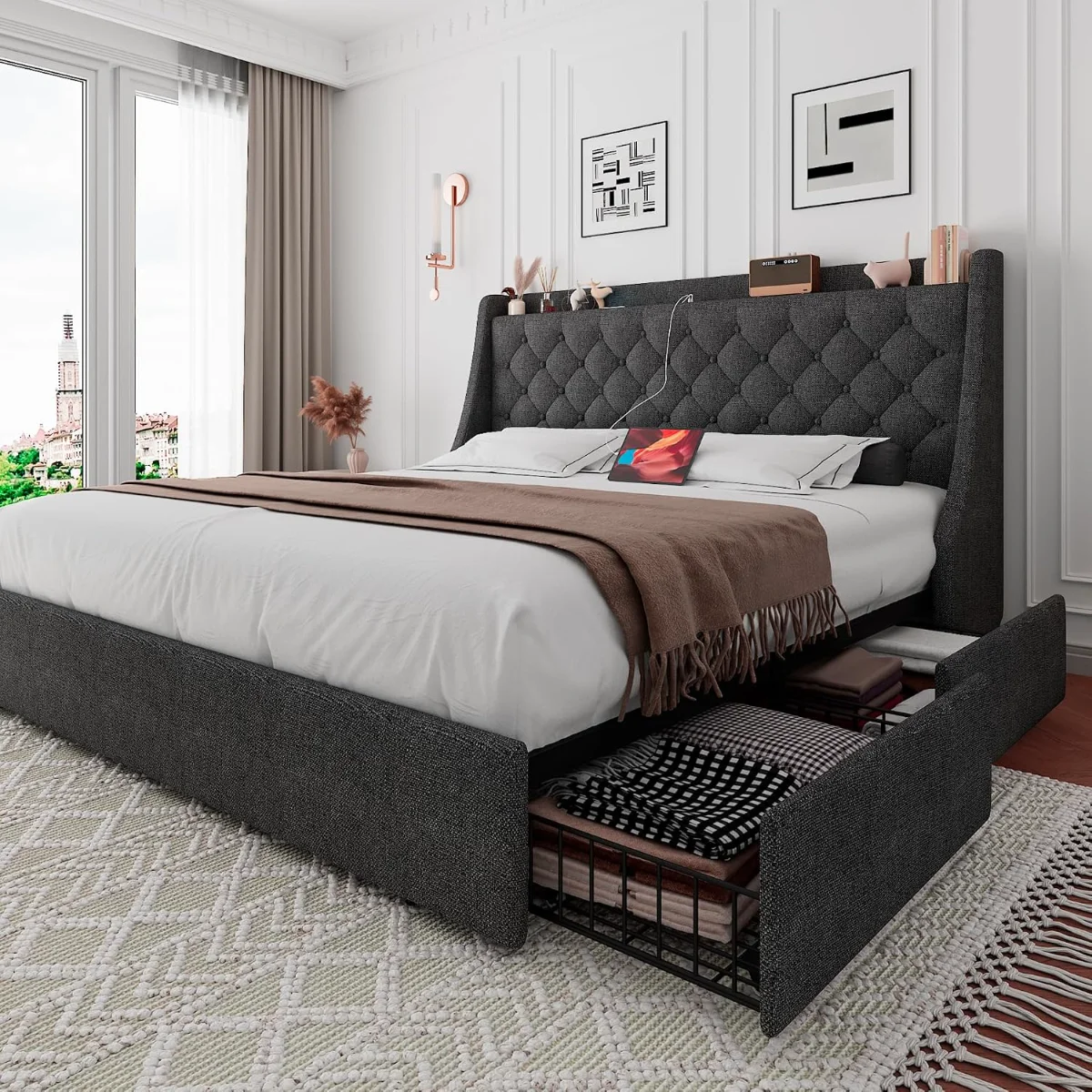
- The three numbers that decide everything
- Slat spacing, and the warranty clause nobody reads
- Weight capacity is a structural number, not a marketing one
- Why beds squeak, and the three fixes that work
- Metal, wood or upholstered, and what each is actually good at
- Storage under the bed: drawers, lift-up decks and plain clearance
- Charging built into the frame: what it is and what it is not
- Sizing: the room decides before the mattress does
- Bunk beds and children’s frames: the one place a standard applies
- Anchoring, even when the frame does not need it
- Assembling it so it stays tight
- What shortens a frame’s life
A bed frame is the only piece of furniture in a house that holds a moving load for eight hours a night, every night, for years. Nothing else in a home does that. A dining chair gets an hour a day. A sofa gets an evening. A bed carries two adults, a duvet, sometimes a dog, and it absorbs every turn, every sit down on the edge, every child who uses it as a trampoline.
Almost nobody buys one that way. People buy the headboard. They look at a photograph, decide whether the fabric suits the room, glance at the price and order it. Then in month three something starts to click when they roll over, and in year two the middle of the mattress has a dip in it that no amount of rotating will fix.
Neither of those failures is bad luck. Both are predictable from numbers that are printed before you buy. The numbers are worth reading in the order they matter.
The three numbers that decide everything
Ignore the styling for ten minutes and a bed frame is a platform that has to do three things: hold a mattress flat, carry a load without deflecting, and do both silently. Each of those maps onto a figure you can look up.
| Figure | What it governs | What to look for |
|---|---|---|
| Slat spacing | Whether the mattress is supported evenly or sags between slats | Gaps of about three inches or less for foam and hybrid mattresses |
| Weight capacity | How much the frame carries before joints start to work loose | Total load, not per person. 800 lbs and up on a queen is a real number |
| Centre support | Whether the middle of the bed drops before the edges do | Legs down the centre line, not only at the four corners |
| Under-bed clearance | What fits below, and how easy the floor is to clean | Stated in inches from floor to the underside of the rail |
| Assembly time | How many joints there are, and therefore how many can loosen | A frame that goes together in half an hour has fewer places to fail |
Every bed page across bedroom states all five of those, in the same words, so two frames can be compared without opening a box. That is deliberate, and it is the part of a catalogue most people never get.
Slat spacing, and the warranty clause nobody reads
Slat spacing is the distance between the wooden or steel bars that the mattress rests on. It sounds like a detail. It is the single most consequential number on the page, for a reason that has nothing to do with the frame.
Mattress warranties almost always carry a support clause. The wording varies, but the substance is consistent: the mattress must sit on a surface that supports it evenly, and where slats are used, the gap between them must not exceed a stated figure, commonly around three inches for foam and hybrid mattresses. Exceed it and the warranty stops applying. Not because anybody is being unreasonable, but because a foam mattress on widely spaced slats develops permanent ripples along the gaps, and no manufacturer can be asked to guarantee against that.
So the frame does not just have to hold your mattress. It has to hold it in a way that keeps the mattress guarantee alive. A cheap frame with slats five inches apart can quietly cost you a mattress, and the mattress is usually the more expensive half of the pair.
Slat count is the shorthand most pages give you. A queen frame with twelve to fourteen wooden slats is in the right territory; the metal frames in our range use reinforced square steel slats packed closer still, and one of our bunk frames runs twenty two slats across a twin. Count and spacing are two views of the same fact, and either one answers the question.
One more thing about slats: whether they are fixed. A slat that simply rests in a channel will walk sideways over months of use, opening a wide gap somewhere in the middle of the bed while the ends stay tidy. Frames that secure each slat, with a clip, a snap fitting or a strip of hook and loop tape, keep the spacing they were built with. Ours do, and the fastening is also half the answer to the noise problem below.
Weight capacity is a structural number, not a marketing one
A stated capacity of 1000 lbs on a queen frame sounds absurd until you work out what the load actually is. Two adults at an average of 180 lbs each is 360. A queen mattress runs from 60 lbs for foam to well over 100 for a hybrid with pocket springs. Bedding adds twenty. That is around 500 lbs sitting on the frame before anybody has jumped on it, and dynamic loads during normal movement can spike well above the static weight.
The number is not there so you can load a tonne onto the bed. It is a proxy for how the frame is built: how thick the steel is, how many legs reach the floor, whether the joints are bolted or clipped. A frame rated at 1000 lbs and a frame rated at 350 lbs are not the same object with a different sticker. They differ in gauge and in leg count, and the difference shows up years later as a frame that is still square or one that racks slightly every time somebody sits on the edge.
Read capacity together with leg count. Four corner legs on a queen means the middle of the frame is a bridge, and bridges deflect in the middle. Our low profile storage frames run legs down the centre line and quote 1000 lbs; the twin metal frame uses six legs under a much smaller span for the same figure. Same rating, different geometry, and the geometry is the part that tells you where the load actually goes.
Why beds squeak, and the three fixes that work
A squeak is friction between two parts that are moving against each other when they should not be. In a bed there are only three places it can come from, and knowing which one you have tells you whether it is fixable.
The first is slat against rail. Bare wood resting on bare steel, or bare wood on bare wood, rubs every time the load shifts. This is the most common source by a wide margin, and it is also the easiest to design out: a strip of foam or a fabric tape between the slat and the ledge it sits on eliminates the contact. Our frames use foam strips or hook and loop fastening at every slat bearing point for exactly this reason. If you have an older frame that clicks, a length of adhesive felt under each slat end is a genuine repair rather than a bodge.
The second is a loose bolt. Every bolted joint on a bed loosens over the first few months as the timber compresses slightly and the frame settles into square. This is normal and it is why the instructions tell you to retighten after a few weeks. Almost nobody does. A bed that has developed a knock in month four is usually a bed nobody has gone round with the allen key.
The third is the frame against the floor or the wall. A leg on an uneven floor rocks between two positions, and a headboard a quarter inch off the wall taps it. Felt pads and pushing the frame flush solve both in about a minute.
Metal, wood or upholstered, and what each is actually good at
The three constructions in our range are not tiers of quality. They solve different problems, and the right one depends on the room and on who sleeps in it.
| Construction | Strong at | Trade-off |
|---|---|---|
| Steel platform | Load per pound of frame, low price, nothing to absorb spills, easy to move | Hard edges, and a headboard is decorative rather than comfortable to lean on |
| Upholstered platform | Leaning back in bed, warmth in the room, hiding the frame entirely | Fabric needs vacuuming, and a spill is a cleaning job rather than a wipe |
| Wood and composite panel | Storage integration, drawers, a solid look, weight that stays put | Heavier to move, and panel edges do not like standing water |
Upholstery is worth a note of its own because it is bought for looks and kept for a reason nobody predicts. A tall padded headboard turns a bed into somewhere you can sit up and read without a pile of pillows collapsing behind you. Wingbacks take that further: the sides stop pillows sliding off, and on our sixteen inch wingback the tops of the wings double as a narrow ledge for a phone or a pair of glasses. That is a small thing that changes how the bed gets used.
Where a frame uses engineered panel rather than solid timber, there is a certification question worth understanding, and it is covered in the block below.
Storage under the bed: drawers, lift-up decks and plain clearance
A queen bed occupies about thirty square feet of floor. In a small bedroom that is a large fraction of the room, and the space under it is the cheapest storage in the house. There are three ways to use it, and they are not interchangeable.
| Approach | What it holds | What it needs from the room |
|---|---|---|
| Open clearance | Boxes and cases you slide in and out yourself | Nothing. Clearance of eight to twelve inches is typical |
| Built-in drawers | Clothes and bedding, reachable without moving the bed | Floor space beside the bed equal to the drawer depth, on the side the drawers open |
| Hydraulic lift-up deck | Bulky, seasonal things: duvets, suitcases, the spare set of everything | Nothing at the sides, but the bed must be clear of the wall behind at the headboard |
Drawers are the most used and the most misjudged. Four drawers under a queen sound like a wardrobe. They hold a great deal, and the drawers on our storage frames run on the long sides so two are reachable from each side of the bed. The catch is pull-out clearance: a drawer twenty inches deep needs twenty inches of clear floor in front of it, and in a room where the bed sits between a wall and a wardrobe, one side of the bed may not have that. Measure before you choose which way round the bed goes.
A lift-up deck solves the clearance problem by going upward instead of sideways. Gas struts take the weight of the mattress so the whole platform swings open on one hinge line and stays there. The entire footprint of the bed becomes one compartment, which is far more volume than drawers can offer, and none of it needs floor space beside the bed. What you give up is casual access. Nobody lifts the mattress to fetch a t-shirt. Lift-up storage is for things you touch twice a year, and it is superb at that.
Plain clearance is underrated. Twelve inches under a twin frame takes storage bins, out of season clothing and, in a child’s room, most of the toys. It also makes the floor easy to get at, which matters more than people expect in a room where dust gathers.
Charging built into the frame: what it is and what it is not
A growing share of our frames build power into the headboard. It is worth being precise about what that means, because the phrase covers two quite different things.
What these panels are is an extension: a mains lead running from the frame to a wall socket, terminating in a block set into the headboard or the storage ledge with AC outlets and USB ports on it. On our frames that is typically two AC outlets alongside a USB-A port and a USB-C port, with 20W fast charging on the Type-C where it is fitted, and a cord long enough to reach a socket that is not directly behind the bed. Our narrow charging nightstand quotes a six and a half foot lead for exactly that reason.
What it is not is a new circuit. It draws from the same socket everything else in the room draws from, and the total load rules that apply to any extension apply here. It also means the lead is a thing that exists, and it wants routing behind a leg rather than across the floor beside the bed.
The reason it is worth having anyway is mundane and real: the socket in a bedroom is almost never beside the bed. Building the outlet into the headboard puts it where the phone actually sleeps, and it removes the cable that otherwise runs up over the mattress.
Sizing: the room decides before the mattress does
Mattress sizes in the United States are standardised closely enough to plan from. What varies is the frame around them, which adds two to four inches on each side depending on the rail, and the headboard, which adds depth at one end.
| Size | Mattress, inches | Suits | Comfortable room |
|---|---|---|---|
| Twin | 38 x 75 | One child or one adult in a small room | 7 x 10 ft |
| Twin XL | 38 x 80 | A tall single sleeper, and bunk upper decks | 7 x 10 ft |
| Full | 54 x 75 | One adult with room to spread, two at a squeeze | 10 x 11 ft |
| Queen | 60 x 80 | Two adults. The default for a main bedroom | 10 x 12 ft |
| King | 76 x 80 | Two adults with a child or a dog joining | 12 x 13 ft |
The comfortable room column is the one people skip, and it is the one that decides whether the bedroom works. The rule behind it is simple: you want about two feet of walking space on any side of the bed you need to walk down, and thirty inches or so at the foot if there is a route past it. A king in a twelve by twelve room fits in the sense that the door still closes, and it also means turning sideways to get to the window.
Two more sizing notes. First, a bed frame quoted as queen takes a queen mattress and is itself a little larger; if you are fitting between two walls, use the frame dimension rather than the mattress dimension. Second, if the room has a door that opens inward, check the swing against the corner of the frame before you commit, because moving a bed six inches is easy and moving a door is not.
Bunk beds and children’s frames: the one place a standard applies
Most furniture is governed by voluntary standards. Bunk beds are different: in the United States they are covered by a mandatory federal rule, and the requirements are specific enough to check against a product page.
Two practical consequences follow. The first is the five inch figure: guard rail height is measured from the top of the mattress, not from the deck, so putting a thicker mattress on an upper bunk reduces the effective rail height and can take a compliant bed out of compliance. Bunk beds state a maximum mattress thickness for this reason and it is not a suggestion.
The second is anchoring. Our bunk frames include anti-tip hardware to fix the bed to the wall, and the guard rails on the twin over twin run 11.2 inches above the deck with a curved entry at the ladder. Neither of those substitutes for the other: the rails stop a child rolling out, and the anchor stops the whole structure moving.
Anchoring, even when the frame does not need it
A bed is low and heavy and is not going anywhere. The furniture that goes with it is a different matter, and a bedroom is where most tip-over incidents happen because it is where the tall storage lives.
The pieces that go with a bed, which is to say the wardrobe, the tall chest, the bookcase the child climbs, all ship with anti-tip hardware in our range and all of them should be fitted with it. The full argument, including how to anchor into different wall types, is in Anchoring, Tip-Over and the Rules Behind Storage Furniture. If you read one other thing after this guide, read that one.
Assembling it so it stays tight
Frames in our range assemble in roughly thirty to forty minutes with the tools in the box. The order matters more than the speed.
- Unpack everything and match it to the parts list before you start. Missing hardware discovered at step nine means the frame spends the night in pieces.
- Assemble on carpet or on the flattened carton. A bare floor scratches the finish and, more to the point, scratches the floor.
- Start every bolt by hand and leave them all loose until the frame is square. Tightening as you go pulls the frame out of true and the last panel will not line up.
- Square it, then tighten in a diagonal pattern rather than going round the perimeter.
- Fit the slats last, and check that each one is seated on its ledge along its whole length rather than perched on the lip.
- Put the date in your phone for three weeks out and go round every bolt again. This is the step that prevents almost every squeak we hear about.
One extra note for storage frames: build the drawers or the lift mechanism with the frame in its final position if you can. A queen with four loaded drawers is not a thing two people slide across a room, and the hydraulic decks are heavier still.
What shortens a frame’s life
Bed frames rarely break. They loosen, and then the looseness does damage. Four habits cover most of it.
- Retighten twice a year. Ten minutes with the supplied key, and it resets the whole frame.
- Rotate the mattress rather than the frame. Uneven loading on the same slats for years is what puts a dip in a bed.
- Keep water off panel edges. Engineered board is stable in a dry room and swells where standing water reaches a cut edge. That is the reason our bathroom pieces are finished on all faces and bedroom pieces are not.
- Do not sit on the same spot on the edge every day. The corner of a frame is the one place with a real cantilever, and a decade of it tells.
A frame treated that way outlives the mattress on it by a wide margin, which is the whole point of buying on numbers rather than on a photograph. The rest of the room, including the nightstands, wardrobes and vanities that go with these frames, is on bedroom, and the same three figures appear on every page of it.
If you are furnishing the room around the bed at the same time, the sizing arithmetic for the rest of the house works the same way, and the dining room version of it is in How Big a Dining Table Do You Actually Need.